
Blakeney Point is one of Norfolk’s most important sites for breeding terns. Each spring, these coastal seabirds return to the shingle, sand and dunes of the Point to feed, court, nest and raise their young.
Four species of tern have traditionally been associated with breeding at Blakeney Point: Common Terns, Little Terns, Sandwich Terns and Arctic Terns. The number of birds and breeding pairs varies from year to year, depending on factors including weather, food availability, tides, predation and conditions at other nearby colonies.
During the breeding season, parts of Blakeney Point are protected to reduce disturbance to these ground-nesting birds. The colonies can be particularly sensitive to people and dogs approaching nesting areas.
Main breeding period | Spring and summer |
Breeding habitat | Sand, shingle and open coastal ground |
Diet | Mainly small fish and other marine prey |
Nesting | On the ground |
Species associated with Blakeney Point | Common, Little, Sandwich and Arctic Terns |
Main threats | Disturbance, predators, flooding and extreme weather |
Protection | Fencing, monitoring and seasonal management |
Best time to see breeding terns | Late spring and summer |

Common Terns are medium-sized terns with pale grey upperparts, white underparts and a distinctive black cap. They are regular breeding birds at Blakeney Point, although their numbers can vary considerably between years.
They typically nest on open ground within the protected areas of the Point and feed by catching small fish from coastal waters.
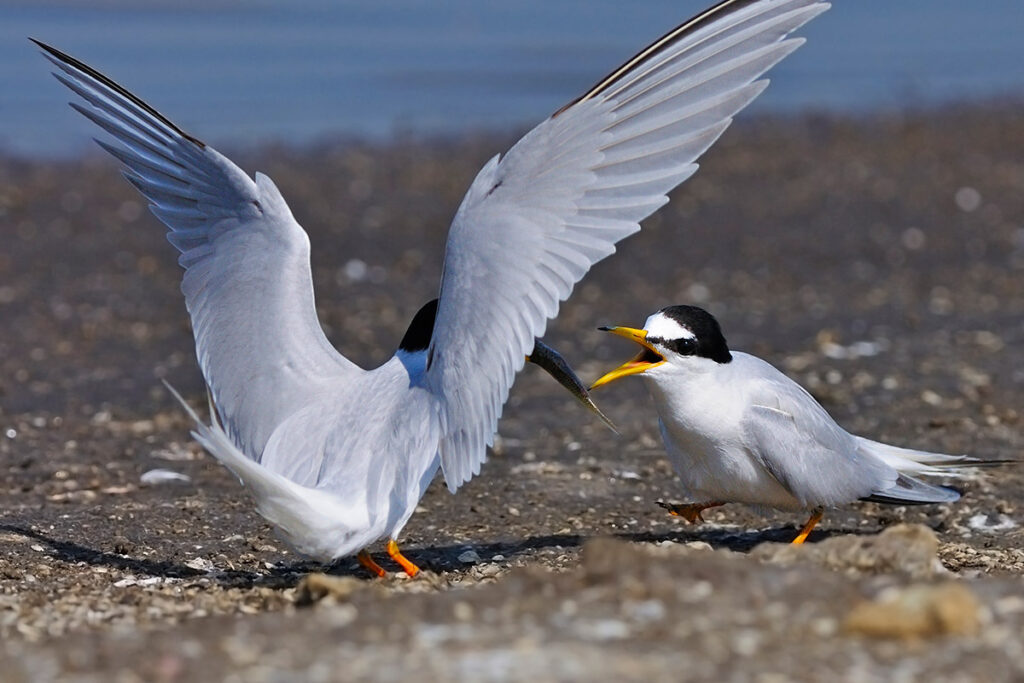
The Little Tern is Britain’s smallest breeding tern and is particularly associated with open sandy and shingle beaches.
Blakeney Point is an important breeding site for the species, and the Little Tern has a long history of breeding here. Their nests are extremely vulnerable because they are simple scrapes on the ground, often close to the high-water mark.

Sandwich Terns are larger than Common and Little Terns and can be recognised by their black crest, pale grey wings and distinctive black-tipped yellow bill.
Historically, Blakeney Point has supported very large Sandwich Tern colonies. In some years thousands of pairs have nested here, although breeding numbers fluctuate and birds may move between nearby colonies depending on conditions.

Arctic Terns are another species historically recorded breeding at Blakeney Point. They are smaller than Sandwich Terns and are famous for their exceptionally long migration between their northern breeding grounds and the Antarctic region.
They can occur at Blakeney Point during the spring and summer, although their breeding numbers are much smaller than those of the principal Common, Little and Sandwich Tern colonies.
Terns are highly specialised coastal hunters.
They spend much of their time flying over the sea or shallow coastal waters looking for small fish. Once prey is spotted, a tern may hover briefly before diving into the water to catch it.
During the breeding season, adult birds carry fish back to the colony to feed their mates and growing chicks.
Watching adult terns repeatedly leave the colony and return carrying small fish is one of the characteristic sights of the breeding season at Blakeney Point.
A boat trip around Blakeney Point can provide an excellent opportunity to see the wildlife of the Point from the water.
During the spring and summer breeding season, terns may be seen flying around the colonies, fishing in the surrounding waters and returning to their nesting areas with food.
Depending on the time of year and the location of the colonies, you may see Common, Little, Sandwich or Arctic Terns, as well as other breeding coastal birds.
The exact wildlife seen on any trip naturally varies according to the season, weather, tides and conditions on the day.
We use cookies to personalise content, provide social media features, and analyse our traffic. We also share information about your use of our site with our analytics partners. You can change your preferences at any time.