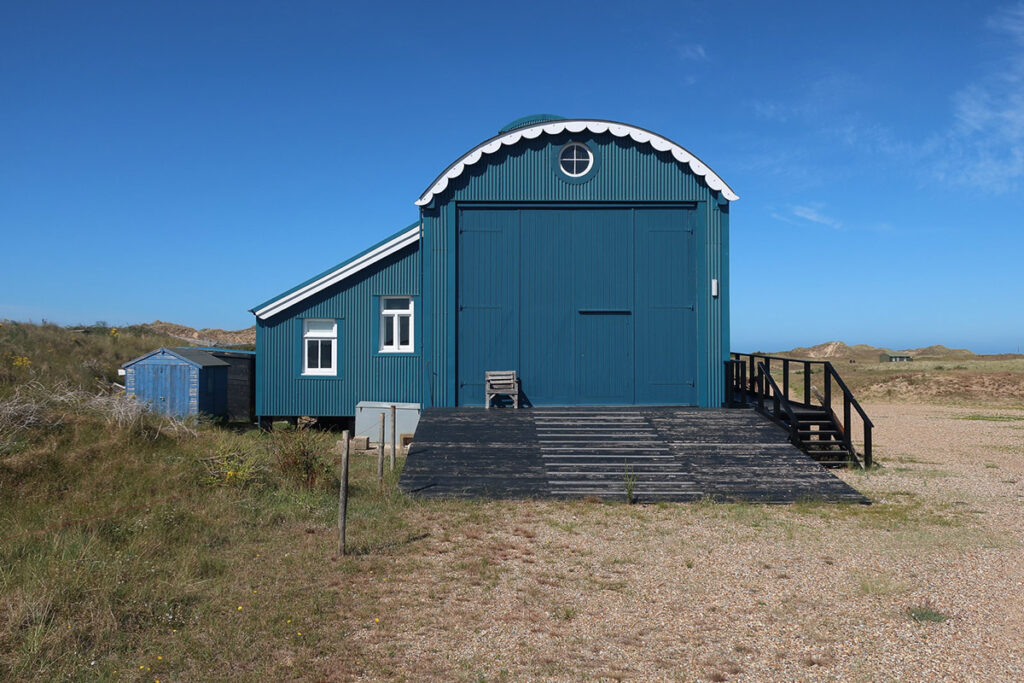
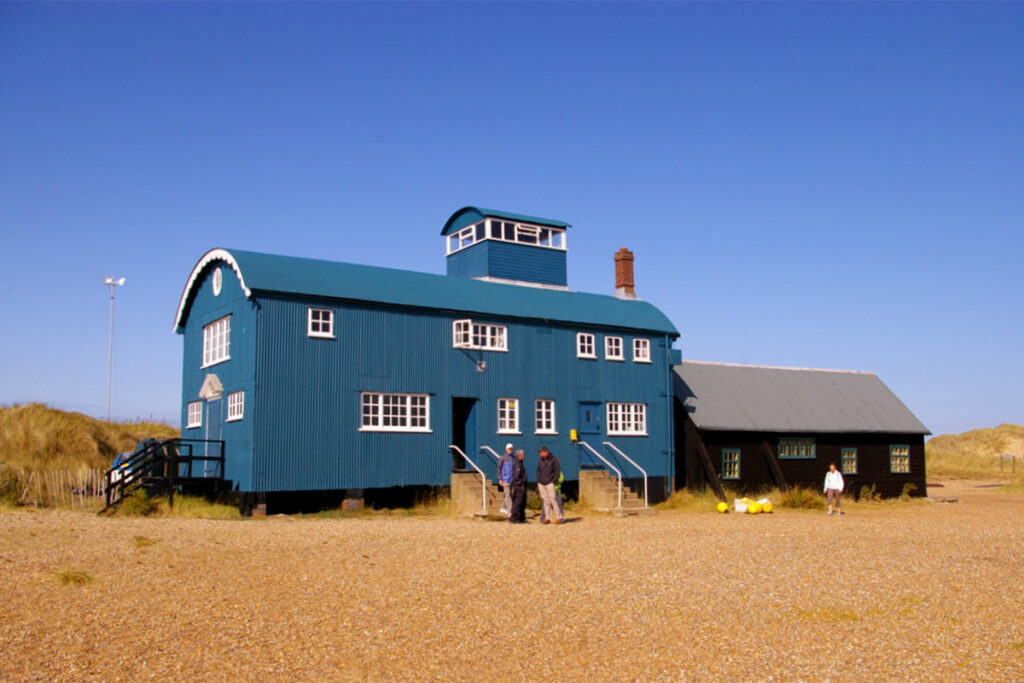
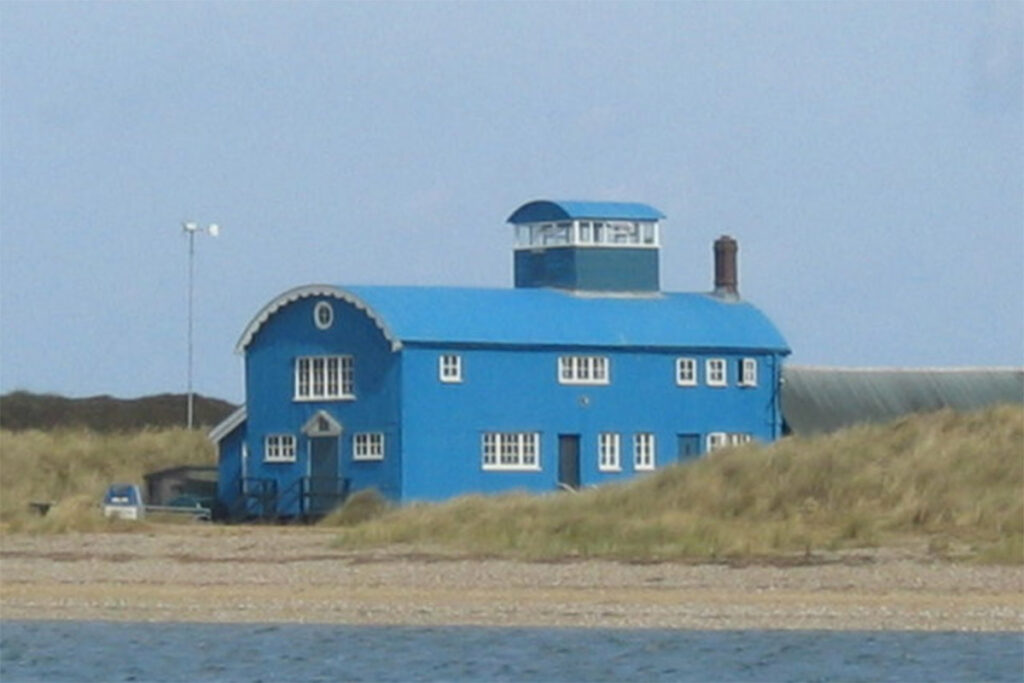
The distinctive blue Lifeboat House on Blakeney Point is one of the most recognisable landmarks on the North Norfolk coast. Standing among the dunes and shingle towards the end of Blakeney Point, the building has an unusual setting. There are no buildings surrounding it. Instead, it sits within the open coastal landscape of Blakeney National Nature Reserve, overlooking the waters around Blakeney Harbour and the North Sea.
On our boats The Lifeboat House is often one of the first historic features to catch the eye as the Point comes into view… It is also a building with a fascinating story.
The Lifeboat House was originally built for a very practical reason: to provide a base for the local lifeboat and its crew. Over the years, however, its role changed dramatically. The building became associated with the Coastguard during the Second World War similar to the Watch house at Blakeney point and later with the conservation and management of Blakeney Point.
Today, it is part of the landscape that attracts visitors to the area for its wildlife, scenery and history. For anyone joining us on our trips, the Lifeboat House provides an interesting link between the working coastline of the past and the wildlife-rich landscape visitors experience today.
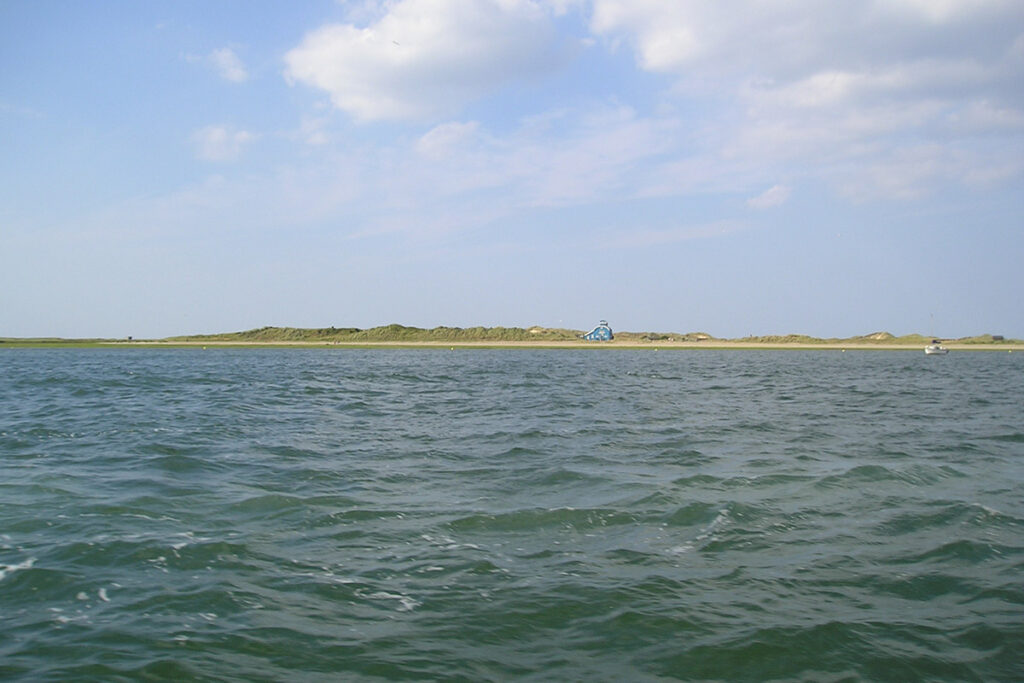
The Lifeboat House is towards the outer end of Blakeney Point, the long shingle spit extending out from the North Norfolk coast.
Its position makes the Lifeboat House particularly easy to recognise. Viewed from the water, the building stands out against the relatively open landscape of the Point. It is also possible to appreciate just how isolated it is compared with a conventional lifeboat station in a town or harbour.
That isolation was once an important part of its purpose. A lifeboat station needed to be close to the sea, giving the crew the best possible opportunity to respond when a vessel was in difficulty. Today, the same location is appreciated for its views and wildlife.
The story of the Lifeboat House begins in the 19th century, when the waters around Blakeney were an important part of local life. Blakeney’s position on the North Norfolk coast meant that local people were familiar with the dangers faced by vessels travelling along the coast and into the harbour. The need for a dedicated lifeboat became particularly apparent following a number of serious incidents.
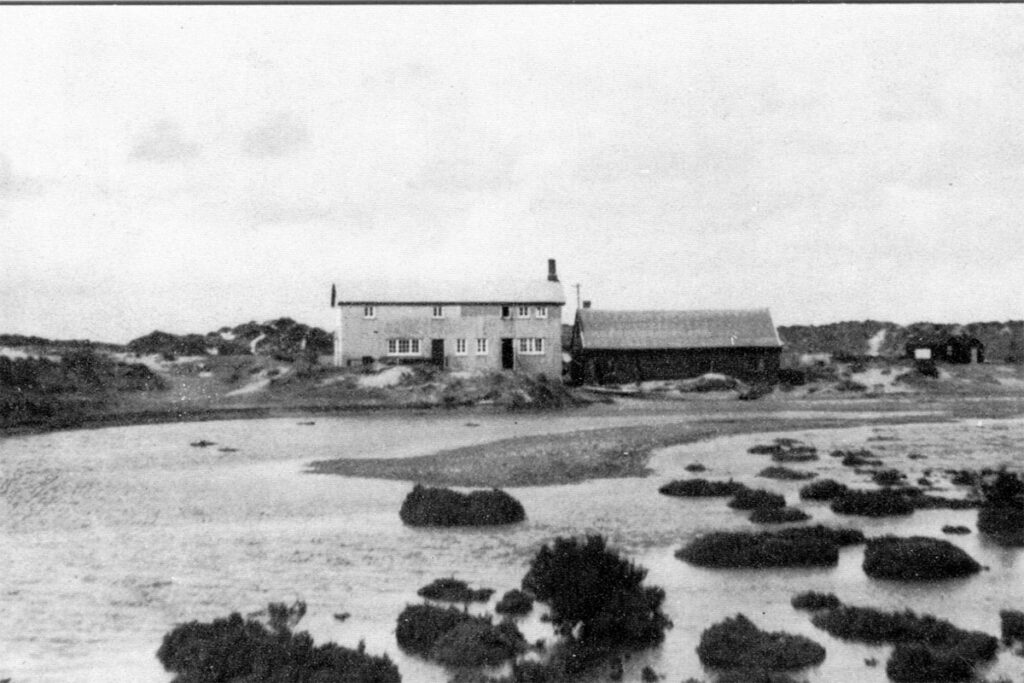
The first lifeboat station at Blakeney Point was established in 1862. The National Trust’s heritage record describes the original building as a large timber structure. The lifeboat service subsequently operated from the Point for more than 70 years!
During that period, several different lifeboats were stationed at Blakeney. Research by the Blakeney Area Historical Society records five RNLI lifeboats serving the station between 1862 and 1935, including the Brightwell, Hettie, Zaccheus Burroughes and Caroline.
These were not modern powered rescue boats. The early lifeboats relied heavily on their crews, who had to row out towards vessels in trouble. The work could be physically demanding and dangerous, particularly in heavy seas and poor weather.
The Lifeboat House therefore represents not just the history of a building, but the history of the people who volunteered to go to sea when others were in danger.

As the lifeboat service developed, a larger building was required. The present Lifeboat House was constructed in 1898 as a replacement for the earlier station. It was built to a standard Type B design, based on the design used at Wells lifeboat station.
The new building was positioned to make use of the existing slipway. This required the earlier lifeboat house to be moved further north, which is why there are actually two historic lifeboat buildings on Blakeney Point. The larger 1898 building is the one that most visitors recognise today. Its curved roof and distinctive profile make it particularly noticeable against the shingle and dunes.
The history of the Blakeney Lifeboat House is closely tied to the crews who operated the boats. The men who served as lifeboat crew members came from the local area and understood the coastline and its changing conditions.
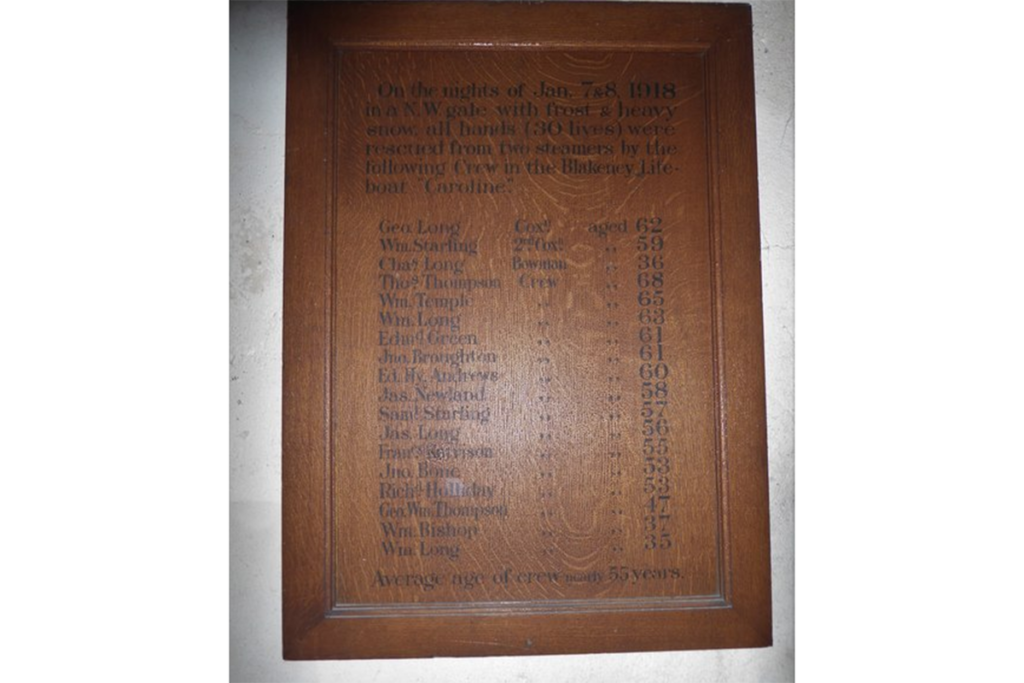
They could be called upon to launch at short notice, sometimes in darkness or severe weather. One of the notable boats to serve at Blakeney was the Caroline, which arrived in 1908. During January 1918, while the First World War was underway, the Caroline was involved in two rescue services in difficult winter conditions. Historical records describe 30 men being rescued over the two incidents.
Stories such as these provide an insight into the important role the station played. The Lifeboat House may appear peaceful today, but there was a time when its doors could have opened onto a very different scene.
The lifeboat station remained in operation until 1935. One of the major problems was the changing geography of Blakeney Point. Waves, tides and storms continually move material along the coast, while dunes and shingle can gradually alter the shape of the landscape.
This had practical consequences for the lifeboat station. The launch arrangements became increasingly difficult as shingle and sand built up around the Point. The Blakeney Neighbourhood Plan records that silting of Blakeney Harbour was a significant factor in the decision to discontinue the lifeboat service in 1935.
The end of the lifeboat service was therefore closely connected to the changing coastline. The building survived, even though the original reason for having it there had disappeared.
The building was not finished with its working life when the lifeboat service ended. During the Second World War, the Lifeboat House became a base for the Coastguard.
A lookout tower was added so that the sea and sky could be monitored for potential enemy activity. This was another period when the isolated position of the building became an advantage.
The same views across the sea that had once been relevant to lifeboat crews were now useful for coastal observation.
It is a fascinating contrast with the landscape visitors see today. During the war, people stationed at the Lifeboat House were looking towards the horizon for an entirely different reason.
The end of the lifeboat service marked the beginning of another chapter in the building’s history. Blakeney Point had already become increasingly important for nature conservation. In 1912, the Point was acquired by the National Trust, following a campaign to protect the area from development. The Trust continues to manage the reserve today.
The former Lifeboat House subsequently became part of the National Trust’s management of Blakeney Point. Rather than being demolished or abandoned, the building was given a new purpose.
Over the years it has been associated with the wardens and rangers like Ajay Tegala responsible for looking after the Point and has also been used as an information point. The building’s role had effectively changed from protecting people at sea to helping protect the landscape on land.
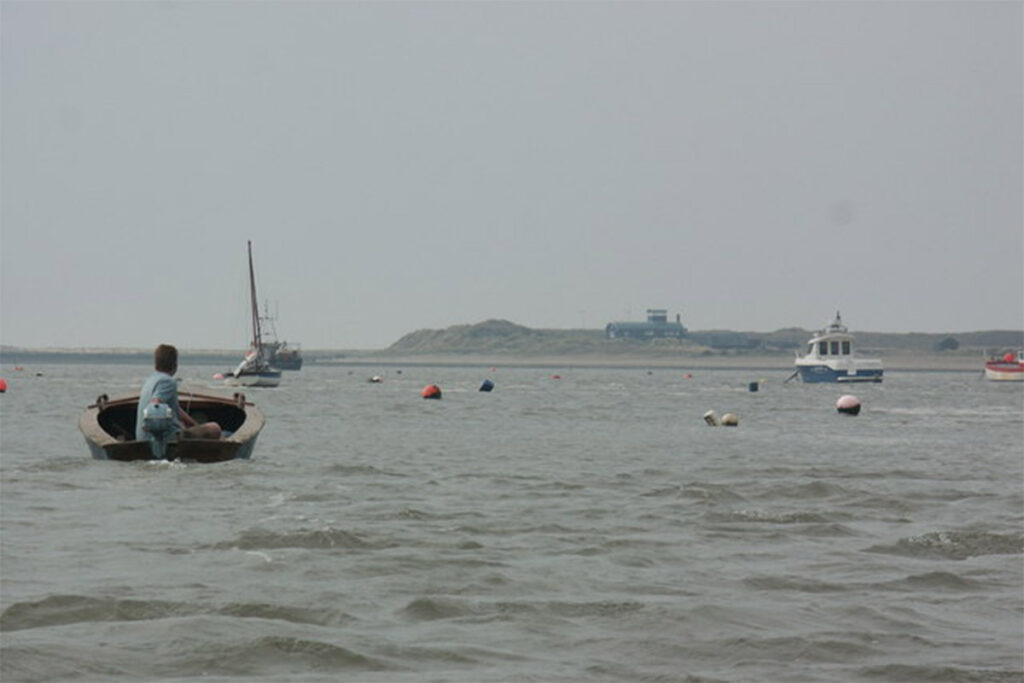
One of the best ways to appreciate the Lifeboat House is from one of our boats. Approaching Blakeney Point from the water gives a completely different perspective from walking along the shingle. The building gradually comes into view against the dunes and shingle, with the open coastline stretching behind it.
From the water, its position becomes particularly clear. You can see how remote the station was and understand why being close to the sea was so important when the building was in use as a lifeboat station.
On our way to see the seals the Lifeboat House provides another interesting historical landmark along the way.